Showing posts with label Electrical Energy. Show all posts

Sunday, April 3, 2011

Solar Energy Benefits!

If you think about it, there are many advantages of solar energy.

First, solar panels can be really reliable. In fact, most people consume electricity for almost 1,000 hours with very minimal or no maintenance. This is because there are no moving parts, so you do not have to replace everything.


And there are a wide variety of solar systems on the Internet to buy almost anywhere. Full of solar collectors, solar fountains to solar chargers, solar outdoor lighting.

In other words, nearly everyone and everyone can take advantage of solar energy.

In addition, there are so many advantages of solar energy as it is environmentally friendly. Solar cells be no harmful toxins that can damage the environment as the emitting fossil fuels, carbon dioxide, certain carcinogens and other greenhouse gases.

And in line with the obvious benefit of solar energy, solar power can be cheaper as compared to buying it from the power company.

Once you break even on the initial installation and thereafter at a profit. Although it is true that there is a standard start-up costs, he begins to pay. Now, compare, if you pay your monthly bills and you get no return on your investment.

Not to mention that the solar energy to sell more power. If you build a sufficiently large solar system, you could even make your electric meter in reverse spin. Check with your local electricity company, for more details, since most utility companies would be more than willing to give you credit or buy this excess electricity.

Another advantage of solar energy is that it is renewable. The power of the sun is always there, always present and abundant. Therefore we do not have drainage, energy, or will run out of concern that infinite source.

Then there are the benefits of government tax credits. On average, the discounts typically covers 20% to 30% of system costs. And most governments would serve some sort of incentives or tax credits for those people to buy solar systems. to give For more details, only your local representative.

And before I forget, is only one of the many advantages of solar energy that you do not have to get connected to the electricity network - yes, talk about comfort minus the hassle! You may already be completely independent, without depending on the power grids more.

Imagine the freedom, and above all the idea that you never pay a penny on your monthly bills!

In addition, solar panels do not create any noise, while in the process of collecting and storing solar energy. Good news for those who dislike the noise on their computers. And remember that there are no other sources of renewable energy will have complete silence.

Saturday, April 2, 2011

What is Wind Power?

Wind energy is energy produced from wind. There are a number of ways to collect and use wind energy and wind power is one of the oldest forms of energy used by humans. can wind mills, wind turbines and wind energy use all sail to a certain degree, and this collection methods are used in many ways. Wind energy is used as a form of clean energy because wind is a completely renewable resource. As of 2008, about one percent of global energy demand has come from wind power is growing by leaps and bounds with the industry.

One way to wind energy is to use the electricity directly. On a sailing ship, for example, the sail is positioned so that the wind pushing the boat along. Windmills are historically wind energy be used to turn millstones or operate a pump for a fountain, with the help of wind energy on site for various needs. These techniques are in use for thousands of years.


In the case of a wind turbine, wind turbine and the rotation of the turbine rotates to produce electricity, a useful form of energy. Electricity is also practical because it can be carried out so that to generate wind energy, which are used in remote locations. This form of wind power is less efficient than using the energy directly, because energy is lost in the conversion and transfer process.


Many nations use wind power programs as part of a larger pressure to clean energy. Wind turbines can be installed in a variety of locations to develop newer and more efficient turbines with companies all the time. Many wind farms are typically windy areas, taking advantage of an abundant supply of wind.

Wind energy is environmentally friendly per se, although it has some environmental advantages. Building turbines requires a high level of resources, as well as the transport of the turbines and creating the necessary infrastructure to transport to the electricity generated. A wind farm can also provide valuable space that could be used for agriculture, habitat for wildlife, or the case. Some companies have on the development of wind turbines that can be integrated into available space, so that a wind farm is multi-purpose work. Others on the use of renewable resources and environmentally sustainable practices in the construction of generators and wind farms to the environmental costs of establishing a system to reduce generation concentrated.

Despite these drawbacks, the wind is considered more appropriate to many forms of energy including coal-fired power stations and nuclear power plants. These methods tend to pollute them, and they use resources that are not renewed. In the case of nuclear energy, while the electricity itself is pretty clean, the management of spent nuclear fuel is a serious problem. Wind energy is also preferred, hydroelectric plants, including the construction of dams to harness connected the energy in the water is. Dams can damage habitats and the health of waterways.

What is Electrical Mechanical Energy?

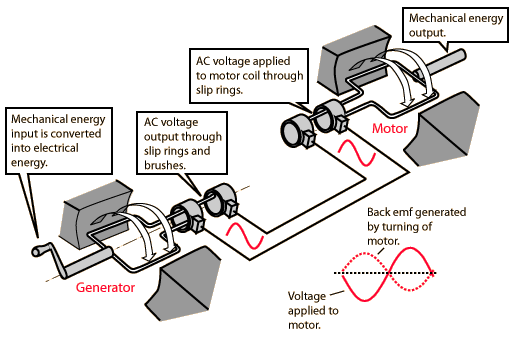
Electrical mechanical energy can be created in one of two ways: using an electric generator or a motor. The concept of electric generator is used to describe a number of devices that convert mechanical energy into electricity. A motor converts electrical energy into mechanical, that is the reverse process of the electrical generator. The energy can be used for a variety of purposes, by a large electric power plant, to be the motor of an electric car use.

It is important to note that there is no such thing as free energy. All energy must be created by something and need a resource. Some type of device is needed to translate the energy from one form to another. For example, solar energy requires the use of solar collectors to trap the sun's rays and convert the heat into electrical energy. This rule applies to electrical and mechanical energy.

An electric generator uses electromagnetic induction to convert mechanical energy into electricity. Mechanical energy is produced by a wind turbine, a hand crank or turbine steam engine. The generator was designed to absorb energy as it is created by the mechanical fastening. The mechanical energy moves the turbine blades, generally against the direction of the magnetic force. This movement generates electromagnetic energy.

The engine is to convert electrical energy into mechanical energy. The electrical energy is produced by the engine, then mechanical energy is created, received by the rotor. This process is the exact opposite of mechanical energy, but has many of the same elements.


Both a generator or motor has a rotor and a stator. A rotor is the actual rotating part of an alternator, generator or motor. The stator is the stationary part, the rotor in position. The anchor is actually produced electric current in the generator and is either built into the rotor or stator. The magnetic field is created by a magnet on the rotor or stator.

Electrical mechanical energy is a common source of power for large power plants and other mechanical equipment. Electrical energy is in high demand, and this constant demand requires the development of new, more efficient forms of exploitation of the electrical mechanical energy. High voltage energy can not be saved, but have available upon request. A career in electrical engineering or mechanical engineering is about the use of this energy source in a variety of designs centered. The positions are devices in electric power generation stations, substations and related.

source:wisegeek.com

Friday, April 1, 2011

What is Electrical Energy?

Electrical energy is the presence and flow of an electrical charge. The energy of the electricity that is found in a variety of phenomena such as static electricity, electromagnetic fields and lightning. People have the ability to use these phenomena and store the electrical charge for later use found. The concept of electric energy is defined using a variety of different terminologies such as charge, current and potential.

Electrical energy is the result of the interaction of subatomic particles with electromagnetic force. to create within an atom, electron and proton charges. This fee can be transferred between devices with direct contact with a conductive material such as a wire.

The date refers to the movement of cargo. With DC, this occurs when the power is stored in a battery and in a direction from the battery. AC occurs when the current changes direction again within an electrical system. The alternating current form is typically used to power larger objects such as houses and buildings.

Electric potential is essential for the selection and the power of the electrical energy. When an electrical charge is present in an object, a force is exerted by its electric field. This speeds up the object in a direction toward or away from the fee, depending on the polarization of electromagnetic. In general, positive charged current pushes the object away, while negatively charged current, the object moves on the field.

Electrical energy may be using a variety of means. The burning of fossil fuels or the heat generated from nuclear reactions steam that drives a generator which in turn creates electricity. Otherwise extracts kinetic energy from wind or water current similar generators. All these methods require a transformer that changes the electrical energy to a higher voltage with lower current. Various methods of storing this energy are capacitors and batteries.


The oldest known civilization, the electric energy were understood by the ancient Egyptians. Texts from 2750 BC refer to the "Thunderer of the Nile" and define the shocks of electric fish. Knowledge and study of fish on through the thousands of Greek, Roman and Arab scholars. Pliny the Elder and Scribonius Largus explores the numbing effect of electric shocks. In addition, a number of Arab scientists determined the same phenomena caused flash.


Until 1600, a large part of the understanding of power as an energy source purely intellectual. William Gilbert, an English physician, studied electricity and magnetism. A number of other researchers used the study of Otto von Guericke, Robert Boyle and Benjamin Franklin. By the 1800s, scientists such as Alessandro Volta had identified a way to use electricity in a battery format. This has been perfected over the years by engineers such as Nikola Tesla and Thomas Edison.

source:wisegeek.com