Showing posts with label Civil Engineering. Show all posts

Monday, August 1, 2011

What is Civil Engineering?

Civil engineering is one of the oldest engineering part, since civil engineers of one form or another have been around ever since humans started building major public works such as roads, bridges, tunnels, and large public buildings. It is also an incredibly broad discipline, spanning treatment of environmental issues, transportation, power generation, and major structures. To become a civil engineer, someone must typically study engineering at a university and then participate in field work for practical training. Many nations also require that students of civil engineering pass a competency exam to ensure that they will be able to design and build safe, stable structures.

There are numerous parts of civil engineering, and a wide range of specialties. Some civil engineers focus on conception and initial design of a project, analyzing the site, the needs, and the resources to come up with a workable project plan. Others specialize in contracting, physically building the structure, managing the site crew, and handling materials and supply. In other cases, civil engineers focus on maintenance of the project after it is completed, to make sure that it is safe and useful.
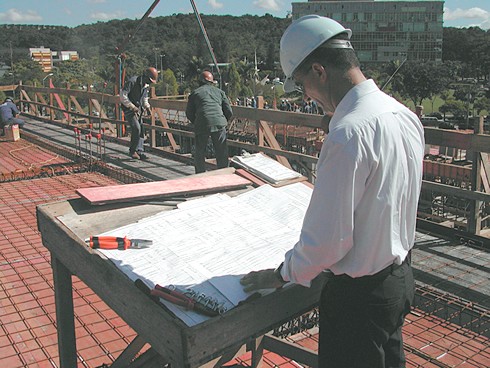
Most people pick a civil engineering focus while they are receiving an education. Engineers who focus on transportation, for example, might choose to specialize in building bridges, tunnels, and roads. Others might lean towards power generation facilities, water treatment, waste management, construction of light railways and subways, or numerous other disciplines. In all cases, extensive training is undertaken so that the prospective civil engineer understands his or her chosen field in depth. Behind every major public works is a team of civil engineers.

One of the primary concerns of civil engineering is public safety and health. A value is also placed on building structures which are functional, efficient, and also aesthetically pleasing. Structural soundness, conformity with local codes, and functionality are all issues which are faced in the discipline of civil engineering. Some civil engineers work directly for the public in the form of government agencies, while others find employment with public firms.

Education does not end with a degree and a course of fieldwork with trained and experienced civil engineers. Continuing education is also an important part of civil engineering. As advances are made in the field, engineers are expected to keep pace with them, especially when the advances improve safety for workers and the public. There are numerous civil engineering trade journals and annual conferences to keep engineers updated in their career field.

wisegeek.com

Monday, February 7, 2011

Hoover Dam-Bypass Bridge

A new bypass bride is built on the Colorado River near Hoover Dam. This project was completed in 8 years at a cost of $ 240,000,000. The 1,900-foot engineering marvel 890 meters above the Colorado River sits to drastically cut travel time along the main route between Las Vegas and Phoenix are recognized as drivers no longer have their way over the dam's winding two-lane road made up at a snail's pace.


"I know that the Hoover Dam is one of the wonders of the world," U.S. Transportation Secretary Ray LaHood said at a dedication ceremony on Thursday. "I do not know who is this name, but I hope that the bridge is another wonder of the world."

LaHood and his delegation of government officials, including Arizona Governor Jan Brewer, and U.S. Senate Majority Leader Harry Reid of Nevada rang, the span linking the silver and the Grand Canyon State as a key example of it worked to update nationwide infrastructure of the country.

source:menscrunch.com

Bandra Worli Sea Link - India's Civil Marvel

If we change from western suburbs to the islands of Mumbai, the only way out was to this day Mahim causeway. But today with the opening of the Bandra Worli Sea Link project of Sonia Gandhi's life of commuters would be much easier. Formerly with the unavailability of a different route, the distance of 8 km took almost 40 minutes, but with the opening of this Indian miracle of technology, the distance would be covered in just under for 10 minutes.

Talking about the engineering side of this project, the two cable-stayed bridges, a 600-meter channel in Bandra and the other twin-tower supports 350-meter at Worli channel of its kind in India. This eight-lane bridge has a cable-stayed bridge tower, nearly 43 stories high. The Cable Stay comprises 2250 km of high-strength galvanized steel wire that support these 20,000 tons of bulky structure. Several teams of engineers from Canada, China, Egypt, Switzerland, United Kingdom, Singapore, Thailand, Hong Kong, Serbia, Indonesia and the Philippines have been working on the project.

Bandra-Worli Sea-Link

It is built with the cost of more than 1,650 crore and it took 10 years to built it. The construction was marred by litigation by environmentalists and fishermen. But eventually it was built with a lot of changes. But it is believed that nearly 100 crore per day in terms of time and save fuel.

Some other facts about Bandra Worli Sea Link

1.The bridge lighting at a cost of about Rs 9-crore done (Rs 90 million) of Bajaj Electricals
2. Bandra-Worli sea is likely to consume 1,000 KW of electricity per day and this would be supplied by Reliance Power and the Brihanmumbai Electric Supply and Transport.
3. It is built as a BOT that is, operate and transfer built. A toll gate is installed and each commuter has to pay out of use of the sea

Here's a video we got hold on youtube. Thanks to our visitors - Sanjana that this link sent to us.

Friday, February 4, 2011

China builds world's longest bridge

26.4 long miles of Qingdao Haiwan Bridge would easily cross the English Channel and is nearly three miles longer than the previous record holder, the Lake Pontchartrain Causeway in the U.S. state of Louisiana.

The great structure connecting the center of the booming port city of Qingdao in east China's Shandong Province with the suburb Huangdao, spanning the vast blue waters of the Jiaozhou Bay.

Built in just four years at a price of £ 5500000000, shows the sheer scale of the bridge of the progress made by Chinese engineers in recent years made.


No longer dependent on Western know-how for such ambitious projects is the six-lane road bridge of more than 5,200 columns it was developed by the Shandong Gausu Group. When it opened to traffic later this year, the bridge is expected to carry more than 30,000 cars per day and the commute between the city of Qingdao and the sprawling suburbs of Huangdao of between 20 and 30 minutes cut.


At least 10,000 workers in two teams around the clock on the bridge which was built from opposite ends and connected to build the center in recent days, toiled.

A staggering 450,000 tons of steel was used in its construction - enough for nearly 65 Eiffel Towers - and 2.3 million cubic meters of concrete, the equivalent of filling 3800 Olympic swimming pools.

Chinese officials said that the bridge will be strong enough to withstand a magnitude 8 earthquake, typhoons and the effects of a 300,000 tons ship.

With its economy growing by 16 percent per year, Qingdao is one of the fastest growing and most prosperous cities in China. The main port of the Chinese Navy and home of Tsingtao Beer, China's most famous brew, host of the sailing competitions of the Olympic Games 2008 in Beijing.

Briefly occupied by Germany 1898-1914 Qingdao has mix of early 20th- Century European-style mansions and churches, beaches and saw reputation for fine seafood at one of China's most popular domestic tourist destinations in recent years. It is also considered a highly desirable place to live. A 2009 Chinese survey named as the most liveable city Qingdao China.

Qingdao residents have celebrated the bridge as a long overdue miracle.

"I'm so glad the bridge is finished. The old road between Qingdao and Huangdao am is so crowded, and now my trip will be much easier. We are a tourist city with beautiful beaches, it is important to good transport links" said a commuter on sina.com, China's largest Internet portal.

But people from other parts of China have denounced the huge cost of the bridge, especially since it only cuts the distance between Qingdao and Huangdao of 19 miles.

"To spend billions to save 20 minutes is a waste of taxpayers' money. It's just a show to make the project look like the governor of Shandong well," complained one commentator from the province of Jilin in northeast China.

China is already home to seven of the world's 10 longest bridges, including the world's longest, 102 miles of Danyang-Kunshan railway bridge that runs over land and water in the vicinity of Shanghai.

And with Beijing billion pumped into promoting China's infrastructure, the bridge is not the world's longest sea bridge Qingdao Haiwan be for very long.

In December 2009, work began on a bridge 31 miles, Zhuhai in southern Guangdong province, China's manufacturing heartland, is related to the financial center of Hong Kong. The £ 6500000000 project is expected to be completed in 2016.

Thursday, January 27, 2011

World's Scariest Bridges

All bridges serve a purpose, whether utilitarian or inspirational. And some of them add a significant element of fear. But you do not have to be in a remote part of the world is scary bridges are everywhere, in all shapes, sizes and heights. And crossing over them, the ultimate adventure travel.


Many brave (or foolhardy) travelers are looking for hair-raising bridges for the thrill. The bridges along the route to Colombia National Archaeological Park Tierradentro are a good example. Although it was a safe distance by bus from La Plata, select some adventure on motorcycles riding on slippery bamboo crosses deep into the mountains, where one wrong move means dipping into a turbulent river.

So get ready to put your fears or maybe you find your next adventure with our list of the world's most petrifying bridges.

Aiguille du Midi Bridge
France

Do not look down. At this height you will want to keep your eyes on the panorama of the rugged French Alps blocked. Fortunately, the bridge itself is short, which escape for a simple, if vertigo sets in. But the really afraid of heights probably not even the bridge, the journey must be the cable car that climbs 9200 meters in 20 minutes.

Where: The summit of the Aiguille du Midi in the Mont Blanc massif near Chamonix.

Statistics: 12.605 meters above sea level.


Royal Gorge Bridge
Colorado
America's highest suspension bridge can be breathtaking for some, but can of vertigo left gasping for air because it straight down nearly 90 stories on the Arkansas River below rigid. Completed in 1929, has the bridge does not wind cable stabilize until 1982.

Where: Royal Gorge, Colorado, on the Arkansas River.

Statistics: 969 feet above the canyon, 1,260 feet long.

Trift Suspension Bridge
Switzerland

One of the longest and highest pedestrian suspension bridges in the Alps, was pasture in 2004, built to hikers into a hut again made inaccessible by a retreating glacier. A replacement in 2009, this bridge was higher handrails and stabilizing cables to prevent it from swinging violently in the wind. But there's still an adrenaline rush.

Where: Drift Glacier, near the town Gadmen in the Swiss Alps.

Statistics: 328 feet high, 558 feet long.


Carrick-a-Rede Rope Bridge
Northern Ireland

First things first: No one has fallen this bridge. However, many visitors who simply can not cope on foot to return and have to travel by boat. Previously it was oppressive acts. Built by fishermen, the island was to catch salmon, the original bridge had only one handrail. The suspension bridge was finally popular with tourists, who replaced a thrill, and the National Trust it with a more robust structure with two handrails.

Where: Near Ballintoy, County Antrim, Northern Ireland.

Statistics: 65 meters long, nearly 100 feet above the rocks below.


Puente de Ojuela
Mexico

This bridge leads to a ghost town, but it's the squeaky wooden floor, that makes it scary. Fortunately, steel cables suspended from two towers, a greater sense of shelter. Nevertheless, steel is a relatively new addition: when German engineer Santiago Minhguin built this bridge in the 19th Century, the towers were made of wood.

Where: The ghost town Ojuela, an old mining settlement in the northern state of Durango, Mexico.

Statistics: 1,043 yards long, 2 meters wide, 360 feet above a ravine.


Chesapeake Bay Bridge

Maryland
Drivers are notoriously afraid of this bridge, as it is exposed to frequent and often violent storms. And if the bad weather hits, to forget the visibility: the middle of this five-mile-long bridge and you can get land barely see.

Where: to link spanning the Chesapeake Bay Maryland Eastern and Western coasts.

Statistics: Nearly 5 miles long, 186 feet high at its highest point.


Hussaini Hanging Bridge
Pakistan
Massive gaps between the boards, a wild swing side by side: There is reason to be one of the world's most shocking suspension bridges is considered. While usual wobbly cable and wood bridges in this area, cross the bridge over the fast flowing river Hunza is especially disturbing since the tattered remnants of the former bridge next to the hanging of threads currently in use.

Where: In the village of Hussaini in northern Pakistan crossing the Hunza River.

Statistics:Floodwaters submerged allegedly the bridge, 2010. Because of its paint a popular adventure travel activity, the bridge is expected to be built up again.


Source:oddyfunny.blogspot.com

Tuesday, January 25, 2011

ARBOFORM: 100% Organic Bio-Plastic Material


It looks like wood,you feel it is wood when you touch it but it behaves like plastic .It is a combination of the plastic and wood where plastic and wood are most used materials in the world. :ARBOFORM


We use a tone of oil to create plastic for ‘everything from watches to bicycle helmets. It hasn’t Been easy to find a replacement material That can Be just as tough, versatile and easy to produce, German inventors aim to Have Developed a new material That Has a lot of promise. It “could replace ‘everything plastic using something as natural as wood.It looks like wood and feels like wood. The material IS Called ARBOFORM am and is Produced after Combining lignin, a discarded element of regular wood with natural resins, and flax fiber. Since it IS ideal ARBOFORM can be “any object form molded Into which is Normally made using petroleum products.Once They Are out of use, the products break down ARBOFORM Quickly Into organically and eco-safe by-products like water and carbon dioxide. ARBOFORM can Be Used in just about “any product.


source:www.itechdigitals.com

Thursday, January 6, 2011

The Longest Bridges of The World.

This is a list of the world's bridges longer than 2 kilometres (6,562 ft) sorted by their full length above land or water. "Span" refers to their longest span without ground support. Of the top ten, seven are located in China, and two are located entirely within the U.S. state of Louisiana.

Note: There is no standard way to measure the total length of a bridge. Some bridges are measured from the beginning of the entrance ramp to the end of the exit ramp. Some are measured from shoreline to shoreline. Yet others are the length of the total construction involved in building the bridge. Since there is no standard, no ranking of these bridges should be assumed because they are at a specific position in this list. Additionally, numbers are merely estimates and measures in U.S. customary units (feet) may be imprecise due to conversion error.


Source:wikipedia.
Name↓ Length
metres (feet)↓
Traffic↓ Country↓
Danyang–Kunshan Grand Bridge[1]
Beijing–Shanghai High-Speed Railway
&0000000000164800000000164,800 m (540,700 ft) High-speed rail People's Republic of China People's Republic of China
Tianjin Grand Bridge[2]
Beijing–Shanghai High-Speed Railway
&0000000000113700000000113,700 m (373,000 ft) High-speed rail People's Republic of China People's Republic of China


Friday, December 31, 2010

The Tallest Buildings in the World

When speaking of the tallest buildings in the world, it is imp

ortant to specify exactly what is being measured.Listers must decide if the building is to be measured from sidewalk level or below, whether or not TV towers or masts are included, and whether an antenna, flagpole, or spire should count.A building is considered to differ from a tower in its primary use, being designed for residential, business, manufacturing, or mixed use,

whereas a tower is not.


The Council on Tall Buildings and Urban Habitat, formerly the Joint Committee on Tall Buildings in conjunction with Emporis Buildings,is the authoritative source for information about the tallest buildings in the world, and their list of the tallest buildings, drawn from an extensive database, is based on the height of the building to the structural or architectural top, which includes spires and pinnacles, but does not include antennas, masts, or flagpoles.Prior to 9/11, the twin towers of the World Trade Center in New York City, New York were ranked fifth - 1,368 ft (417 m) – and sixth – 1,362 ft (415 m) – on the list of the tallest buildings in the world.


The height is measured from the level of the lowest, significant, open-air, pedestrian entrance. At the time, the Willis Tower held first place in the second and third categories, the Petronas Towers held the first category and the original World Trade Towers held the fourth. Within months, however, a new antenna mast was placed on the Willis Tower, giving it hold of the fourth category. On April 20, 2004, Taipei 101 in Taipei, Taiwan, was completed. Its completion gave it the world record for the first three categories. On July 21, 2007 it was announced that Burj Khalifa had surpassed Taipei 101 in height, reaching 512 m (1,680 ft).


Since being completed in early 2010, Burj Khalifa leads in all categories (the first building to do so). With a spire height of 828 m (2,717 ft), Burj Khalifa surpassed Taipei 101 as the tallest building to architectural detail and the Willis Tower as the tallest building to tip. It also leads in the category of highest occupied floor.


Before Burj Khalifa was completed, Willis Tower led in the fourth category with 527 m (1,729 ft), previously held by the World Trade Center until the extension of the Chicago tower's western broadcast antenna in 2000, over a year prior to the World Trade Center's destruction in 2001. Its antenna mast included, One World Trade Center measured 526 m (1,726 ft). The World Trade Center became the world's tallest buildings to be destroyed or demolished; indeed, its site entered the record books twice on September 11, 2001, in that category, replacing the Singer Building, which once stood a block from the WTC site.


Structures such as the CN Tower, the Ostankino Tower and the Oriental Pearl Tower are excluded from these categories because they are not "habitable buildings", which are defined as frame structures made with floors and walls throughout.


Tourism Land Turkey

Friday, November 19, 2010

Famous Civil Engineers


Vincent T. H. CHU

Vincent TH CHU is omitted internationally as walking encyclopedia of civil engineering. He has received the Ombudsman's Award 2007, complaint in connection with category and Young Engineer of the Year Award 2008 (Merit), organized by the Hong Kong Institution of Engineers. The following are the main achievements of Vincent Chu in recent years:


(I) Extreme Popularity of engineering books on international scale
Vincent Chu is the author of five internationally popular civil engineering books, namely "200 Questions and Answers on Practical Civil Engineering", "Civil Engineering Practical information AZ", "Ask Vincent Chu (Common FAQ about the practical civil engineering works)," "The underlying causes in engineering practice "and" A Closer Look at prevailing Civil Engineering Practice - What, Why and How ", the result is a list of useful practical experience, Q & As and knowledge, should acquire the engineers. The five books have been written off within 5 years (2005-2009) and they received overwhelming good comments from engineers around the world. They are the "must-read" books of a civil engineer Engineering.

Overwhelmed by easy-to-read style, offered a broad spectrum of engineering knowledge and useful information in the books, about 30 engineering companies, universities and organizations around the world to contain the books on their websites for their member referral fee. About 20 engineering companies, universities and organizations around the world offered to recommend the books to their members. To date, the book is known to Asia (Hong Kong, Japan, Turkey, Singapore, Philippines, Indonesia, Mongolia, Vietnam, Malaysia), Europe (UK, Switzerland, Germany, Bulgaria, Spain, Slovakia, Gospodarska have spread zbornica Slovenije) , North America (United States and Canada), Oceana (Australia and New Zealand) and Africa (South Africa, Nigeria, Kenya and Zimbabwe), Islands (Mauritius, Barbados).

(Ii) the frequency of regular writing columns in engineering journals and websites around the world
Vincent Chu Engineering wrote columns in magazines and international websites on a regular basis. Since some engineers may be busy, to his books, which is very time consuming, have to read it read, Vincent Chu actively liaised with the engineering organizations, some short engineering write columns to share his knowledge and experience with engineers around the world as follows:

Organization Engineering Column
The Hong Kong Institution of Engineers The Civil FAQ (Updated Monthly) in the monthly journal The Hong Kong Engineer
World Federation of Engineering Organizations The Civil Q&A (Updated Monthly)in the official website
The University of Science and Technology (American Society of Civil Engineers – International Student Group) The Civil Corner (Updated Monthly)in the official website
World Council of Civil Engineers Civil Engineering FAQ

Vincent Chu, a freelance technology FAQ E-mail Service "Ask Vincent Chu, prepared in which all civil engineers around the world could their technical problems via e-mail and he will answer them soon. World Federation of Engineering Organizations and the European Council of Civil Engineers helped to promote this free e-mail service. This essentially provides a systematic means to cope with their needs in real-time basis and to help them in their day to day civil engineering.


In addition, Vincent Chu has voluntarily wanted to be part of the Ask an expert on this website, where he answers all questions as soon as possible.

Boeing 747 House


Francie Rehwald a Boeing 747 houses built by the former businesswoman.
'The Wing House (Wing House), David Hertz, designed by the house. Rehwald engaged in buying and selling automobile, whether you want to do something different when it purchased the land the house kondurulduğu called Hertz.


4.5 million pieces of home, 60 meters wide, 70 meters long and 19 meters in height. Rehwald, 35 thousand dollars, bought a house like the old Boeing 747 wants to come out fully explains.


Thursday, November 18, 2010

Akashi Kaikyo Bridge

The Akashi Kaikyo Bridge, popularly known as the Pearl Bridge, has the longest central span of suspension bridge. The central span is breathtaking 1991 meters (6532 ft) and thus is a truly wonderful Civil miracle. The hotel is located in Japan, the Akashi Kaikyo Bridge was busy in 1998 with the aim of linking the city of Kobe on the mainland to Honsho Iwaya on Awaji Island by crossing the street Akashi completed.

Construction Details

Central span - 1991 m (6532 ft)
Steel - 181 000 tonnes (It is said that a total of alternate cable could be used in this bridge include the world 7 times.)
Workers - 2 million
Time-10 years
Concrete - 1.4 million cubic meters

The bridge is using two lines, built the strech between two towers. The road is through other cables that support finally tied up with the main cable. Two large blocks anchor at both ends support of this gigantic structure.


Friday, October 29, 2010

Solar Campus

If you are driving south along Highway 61 from Blytheville, you can catch in the corner of my eye. Today it is just looks like some fantasy written birdbaths in a field, but when they were new, these were parabolic part of the world's largest photovoltaic system, and they helped warmth and flow of the Mississippi County Community College. These six reflectors and the framework for the original prototype solar system have been issued on the grounds of the university obtained. 264 more reflectors and their support structures were sold as scrap to local merchants about five years ago.

So, how is it that this community college come to play in this rural area close to the air and space industry to host this cutting edge technological experiment? And in the same breath, we ask now that solar electric production is always economically practical, why it was discarded built here, where it was right in the physical plant design?

In 1974 the voters of Mississippi County in northeast Arkansas elected three mill tax for the construction of a campus, so that local children had a cost higher education close to coming home. In August 1975, classes began for 800 students in the old Sudbury Primary School. In 1976, the Board bought 80 acres to build on which the new campus.

In 1976 Jimmy Carter elected president. The Arabs had cut off our oil supply. Energy prices rose. Petrol was in short supply. The government decided to experimental alternative energy projects through the Energy Resource Development Administration (ERDA) to finance. Arkansas' national politicians approached college President Dr. Harry Smith with the idea of conversion to MCCC pilot energy project. Not only is the quest for energy independence and the ecologically enlightened patriotic thing to do, but always a big federal project in your district made for good entertainment come election time. Smith was all for it. He hoped that accelerate this high-tech project would his school accreditation process. He expects that international attention would be drawn from this project good for the region. He expects that solar technology courses attended the experiment would make his college a recruiting station for the basic high-tech companies and the financial support could be collected from the companies. You could not swing a cat without getting fur all about synergy.

In February 1977, announced Senator John McClellan, who had been lobbying for the project were that college officials with ERDA, who has agreed to produce a feasibility study for a solar generator of 500 kilowatts would fund had to meet. The Little Rock architectural firm Cromwell, Neyland, Truemper, Levy and Gatchell would draft the administrative and academic buildings. Honeywell will design the heat exchange and energy components. Another group called the Total Energy Applications / Management (TEAM) would also be involved. TEAM was a Washington-and-Little-Rock-consulting firm that coordinated the project, accepted and reviewed bids, deals with the authorities and so on.

At the end of April announced that Vice President Mondale would go ERDA put up $ 5.8 million to 2.5 million dollars in the local money. The local money would go to the campus. The federal government would be money for solar energy functions. President Smith was surprised at the size of the grant. They had asked for $ 4.5M. He was further surprised that the Carter administration envisaged to be an important showcase and testing ground for solar energy technologies.

Something has happened I have not yet figured out. Somewhere between July and August of 1977 increased the ERDA grant money $ 5.8 million to $ 6.3M. The only reason why I was in the newspapers was that delays due to contractors inability within the budget range, but since the extra money came before the first betting round, I'm not sure that the real reason.

After funds were budgeting. If you went to a bank to the money, get something to build on your own, you would first things cost and then ask for the money to cover it. But sometimes government procedures serve motives other than those specified, especially if the administration on how to proactively respond to a crisis would be perceived. In this case, distributing President Carter to make some money as he did see something about the Arab oil embargo, was so the money and the news stories first and details to follow.

From the perspective of the locals, the most important of the follow-on details, the distribution of millions. It is easy to build the cost of building a two-room house, because each year thousands are estimated. You can find one on a plan similar to its built and almost certainly will be, the price in the ballpark and the water and heat and AC and power everything is going to work as advertised. But this stuff was all new solar energy. Although some of the technology was open source, most of the components had never been combined or applied on this scale. For example, General Engineering Laboratory (GEL) from Durham, NC was to store energy in the form of iron redox batteries with a gel electrolyte medium design. I called Bill at Stellar Ball Sun Solar Energy Shop in Little Rock. (One could him as the man who recall the water wheel converted to Dogpatch.) I asked him what an iron redox batttery is and why we want one and why I could not find anyone to sell them on the web. I could only find very few technical documentation and references. Apparently they are not profitable.

Iron redox batteries are a type of hard holy grail advocates of green energy. In discussions on the subject, the words "in theory" come a lot. The technology is very promising in theory. The components are not at all exotic, toxic, in theory, gelatin, water, iron, coal. They are infinitely rechargeable and can be fired without any damage, again in theory.

Lead-acid batteries, such as your car battery wears out after so many thousands of discharges and recharges. As dissolved ions go back and forth from the anode to cathode and back again, a few of them combine with other ions or dissolved oxygen and precipitate out of solution. After a few years, all the metal in the plates in the battery at the end as sludge at the bottom of the battery compartment. Iron redox (reduction / oxidation) batteries, replacing electrons riding gases dissolved in solution and not as dissolved mineral ions, so that the electrodes disintegrate into mud. So in theory can unload an iron-redox battery and charged forever. It does not wear out with normal use. The technique is very well known because it was one of the earliest designs battery and sometimes used to power telegraphs and railway signals in the last century. Another advantage of iron redox batteries is safety. No lead. No acid. Think you have, how much lead and acid you'd have to hand, to save the power of a 500-kilowatt transmitter. Then think of the place as packed with college students and you can see the problems with conventional batteries ask.

The flip side of the iron-redox battery is that a little power you have to store a large horn battery use. An iron redox battery strong enough to fit your car might not start in your car. Of course, if you store energy for an immobile system and you have plenty of room basement, size and weight are not such a problem.

All the excitement of iron redox batteries was made controversial when it became clear that the project get under Plan B, not plan A.

The original proposal by ERDA, the feasibility of guys in Oak Ridge was for an array that would generate 500 kilowatts at noon on a clear day. The feasibility of guys in Oak Ridge ERDA informed that this proposal was too optimistic for the existing technology, and presents two sets of modest goals. A plan proposed a plant energy requirements to 240 usable (that is AFTER losing by circuit and converting direct current to alternating current) kilowatts at peak solar conversion of 2-megawatt-hours of storage accompanies. A rough translation: your production facility can produce one fourth megawatts at noon on a sunny day and you can save about ten hours worth of juice in your batteries.

could 1) the 240 kilowatts, before being measured, rather than after, the loss of inversion and circuits: Plan B was as Plan A with the following changes. Sorting the way companies report EBITDA as if they were real incomes. And 2) instead of 10 hours worth of battery current product information, a stripped-battery system would be large enough to allow for smoothing of the fluctuations in energy through things like passing clouds. So there was some incentive to Plan B, known officially as the move "Option II". The technical goals were easier to achieve, and hinted Mr. Ahearn of TEAM can be that if all bids were over budget, ERDA could come up with some more money.

The project leaders were scrap Plan A and Plan B to shift if and only if none of the contractor submitted a bid lower than the amount budgeted for the construction of the plant.

Honeywell developed a prototype solar panel and shipped it to Blytheville a little under $ 700,000. On the right is a picture of the remains exactly where it was originally installed as a teaching tool. This is the way of the world with the latest technology. One day you're worth two-thirds of a million dollars. In no time you are a parrot perch. Honeywell estimated price of the entire power plant at $ 1.9m. The items in the budget was set at $ 1,491,501 and alternative proposals were sought.

In August 1978 three tenders were submitted. All shoot out three of a mile. The lowest was $ 3.6M. The cost had to be cut, and that meant going to Option II specifications and that meant no iron redox batteries. Some of the other austerity measures have ultimately contributed to the project early end. Firstly, the prototype of a large platter unit, the solar cells pointed in the direction of the flat sunlight. The cells were brand new technology at the time and had to be done manually. They were the single most expensive line items. It has been argued that, if you could thirty times the sunlight on a cell it was similar to that put as much sunlight to thirty individual cells. Therefore, the prototype is flat and installed the devices have finally this parabolic mirror. Solar cells, 62,000 of them were aligned in two rows above the mirror faces down at the reflectors, rather than up in the sun.

The original design called for two triangular supports, one at each end of each 20-foot section. The design you see above places a single vertical I-beams every 20 feet in a three-part series. The structure that holds the gear out of the ground requires less than half of the originally specified materials. If you have 270 sections, adding that up. The original design called for each section, its own automatic tracking mechanism. To save money sections were combined, so that an engine and a set of ganged sensors would orient six reflectors. A dollar here is a dollar.


http://users.aristotle.ne